For years, Jesse* was a fixture on the Ave, the University District’s main street.
He had lived on the same blocks for the better part of a decade. While he was respectful of businesses and people on the Ave, living outside generates issues such as belongings collecting in alleyways, behavioral health challenges happening in public, and more. REACH outreach workers first connected with him in 2019, and building a relationship took years—every day they chatted with him, asked him what he needed, made sure he took his medication, and kept showing up.
The business community also connected with Jesse. A coffee shop started having him take out the recycling in exchange for his morning coffee. When his belongings became nuisance, or his mental health challenges disturbed customers, instead of calling the police, they’d call REACH case managers to help him out and make sure everyone’s needs were met.
A couple of years ago, he started mentioning his grandmother and his family more often. Case managers helped him place the calls to reconnect, and that reconnection opened the door to his own goals, including, eventually, moving inside.
None of it was simple. His first shelter placement was miles south of the only neighborhood he’d known for ten years, so case managers rode the bus with him until he could make the trip on his own. A Public Safety Ambassador employed by the business district, who had known him for many years, gave him an Xbox to use while home, because being indoors and alone is hard for many people who have lived outside. Going inside can mean leaving behind the community a person has spent years building, and for someone carrying trauma, that isolation is its own weight to manage.
It wasn’t simple, but it worked. Not long ago, an outreach worker spotted him walking down the Ave with a bag of groceries, looking like any other neighbor. He’s housed close by now, and he still takes the bus back to the Ave to be among the people who know him.
Jesse’s story is one example of what becomes possible when a neighborhood stops handing its hardest challenges from one agency to the next and starts solving them together. No single program got him there. Coordination between outreach workers, case managers, ambassadors, city staff, and the business community did. It’s an approach Seattle partners have been refining for years: The Neighborhood Impact Framework or NIF.
*Names have been changed to protect participant privacy
What is NIF?
The Neighborhood Impact Framework (NIF) is not a program. It is a system of coordination between programs.
Across Seattle, outreach workers, case managers, community liaisons, ambassador teams, business and neighborhood leaders, and City partners have spent years building services that complement one another. NIF formalizes those relationships into a single, shared structure—one that links a neighborhood’s priorities to the available resources that can address them.
Rather than requiring new programs, NIF coordinates existing ones and scales them to the neighborhood, so partners can narrow their focus and respond faster. In this way, neighborhoods maximize the effectiveness of existing resources and together identify what additional resources may be necessary to solve bigger concerns. The Framework’s priorities are straightforward:
- Identify and prioritize the public safety concerns that a neighborhood is experiencing.
- Keep partners in close coordination so they can respond to those concerns together.
- Create an efficient “front door” to long-term care, so scarce resources reach the issues of greatest community concern first.
NIF grew out of neighborhoods with business improvement areas or BIAs, where formalized coordination roles already existed. But it doesn’t depend on them. Any neighborhood with leadership willing to help identify priorities and coordinate with partners can build the framework.
How NIF works
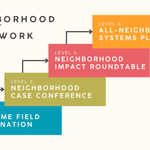
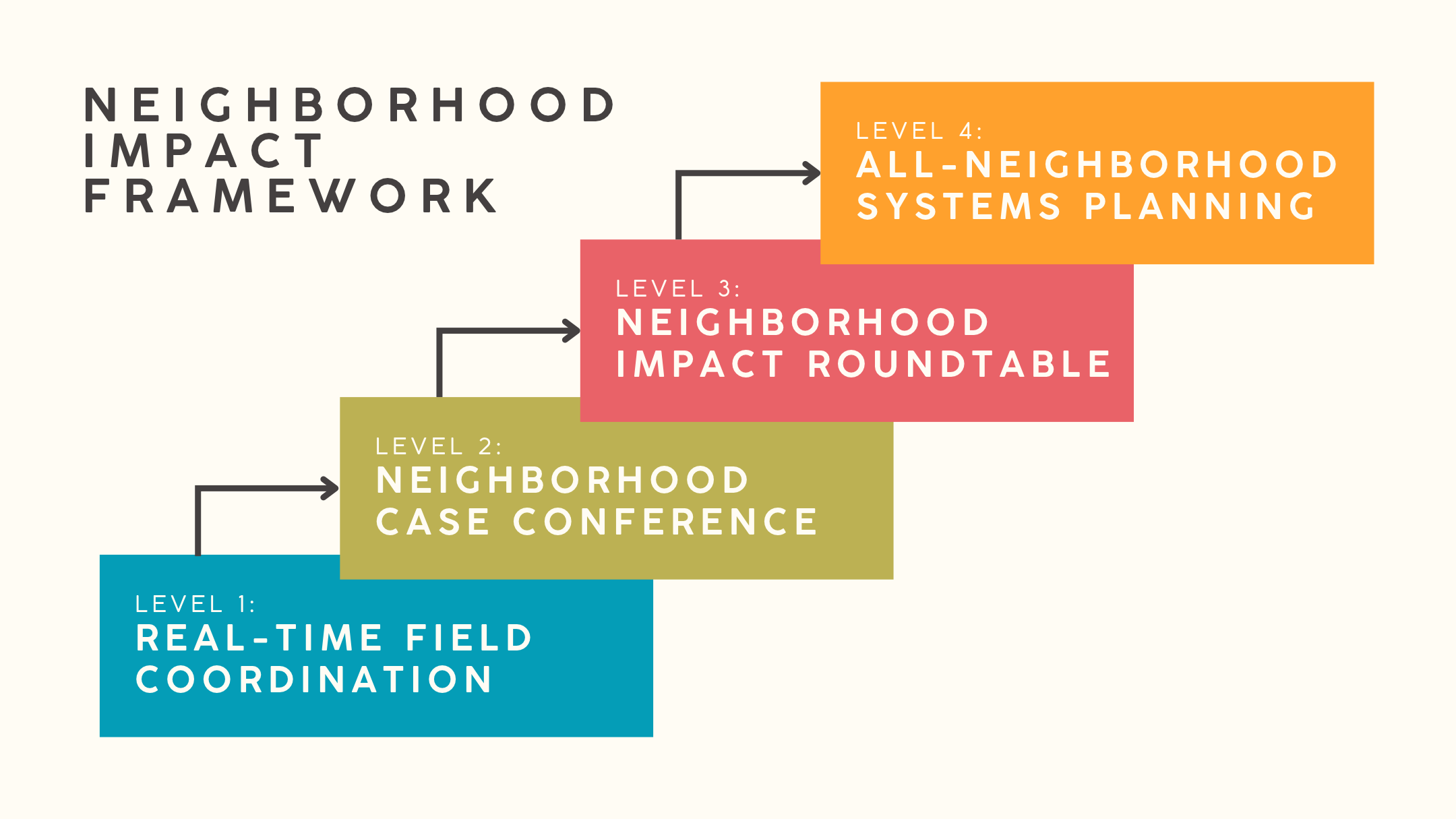
NIF operates in four layers that build on one another. Each layer has a distinct job, and the framework’s value comes from keeping them in conversation.
On the ground, ambassadors and outreach workers are in the neighborhood every day, building relationships and responding in real time. What they learn feeds into neighborhood case conferences, where the teams in direct contact with high-priority people with complex needs come together to share what they know and build a coordinated plan. This plan then shapes the day-to-day work back on the ground.
One level up, neighborhood leaders and service partners meet to take stock: Are people getting housed? Are conditions improving? Where is the system falling short? The gaps they can’t close locally get carried to the top layer, where partners from across the city compare what’s working, name what needs to change, and push for the policy and resource solutions no single neighborhood can win alone.
Where NIF is now
Different neighborhoods are at different stages and capacities to implement the Neighborhood Impact Framework, and part of the work now is helping them learn from one another, so no one starts from zero.
Some neighborhoods, like Lake City and Capitol Hill, are building the core components needed to begin. Others, like the Chinatown-International District, are running the framework but don’t yet have every piece in place. And a few, like the U-District and Ballard, have reached full fidelity to the practices partners have identified as most effective—where the biggest remaining barrier isn’t coordination but access to long-term care, like shelter and specialized behavioral health support.
What we’ve learned
- Individual impact matters. Even one person can shape a neighborhood’s sense of safety.
- Relationships work. Trust-based engagement is what makes progress possible.
- Local coordination enables deeper, more responsive care. A tight geographic focus lets partners know a neighborhood’s people and adjust plans as conditions change.
- Clear plans build trust. Transparency and honest timelines make room for complex work.
- Resource gaps persist. Success ultimately depends on system capacity, including housing, behavioral health care, and flexible service options.
What’s next
NIF’s next chapter comes down to two things: building and maintaining the core components in more Seattle neighborhoods and investing in the long-term care the framework connects people to, such as low-barrier, high-support shelter; mobile behavioral health; and intensive case management. The framework is the front door. It works only when there’s somewhere for that door to lead.
That somewhere is now coming into view. Backed by a downtown coalition—the Downtown Seattle Association, REACH, Purpose Dignity Action, Everyone Deserves Housing, the Downtown Emergency Services Center, the Unified Care Team, and others—Mayor Katie Wilson announced Streets to Housing, a citywide approach that moves from brief outreach and repeated sweeps toward sustained, neighborhood-based outreach paired with shelter and services matched to what people need. Outreach workers would be assigned to neighborhoods rather than council districts, building a by-name understanding of who is living outside and staying with them from the street through shelter and into housing—the same practice NIF has been refining block by block. The plan rests on the City Council funding a two-year, $37 million shelter investment that would add roughly 960 beds.
That pairing is what NIF has needed most. For years, outreach workers, ambassadors, and neighborhood leaders have been able to identify the people whose circumstances weigh heaviest on a block and build plans around them—but rarely with reliable access to the shelter and care those plans depend on. Streets to Housing is built to close that gap, joining the coordination NIF provides to the capacity to act on it.
Read more about Streets to Housing and stay tuned for updates.