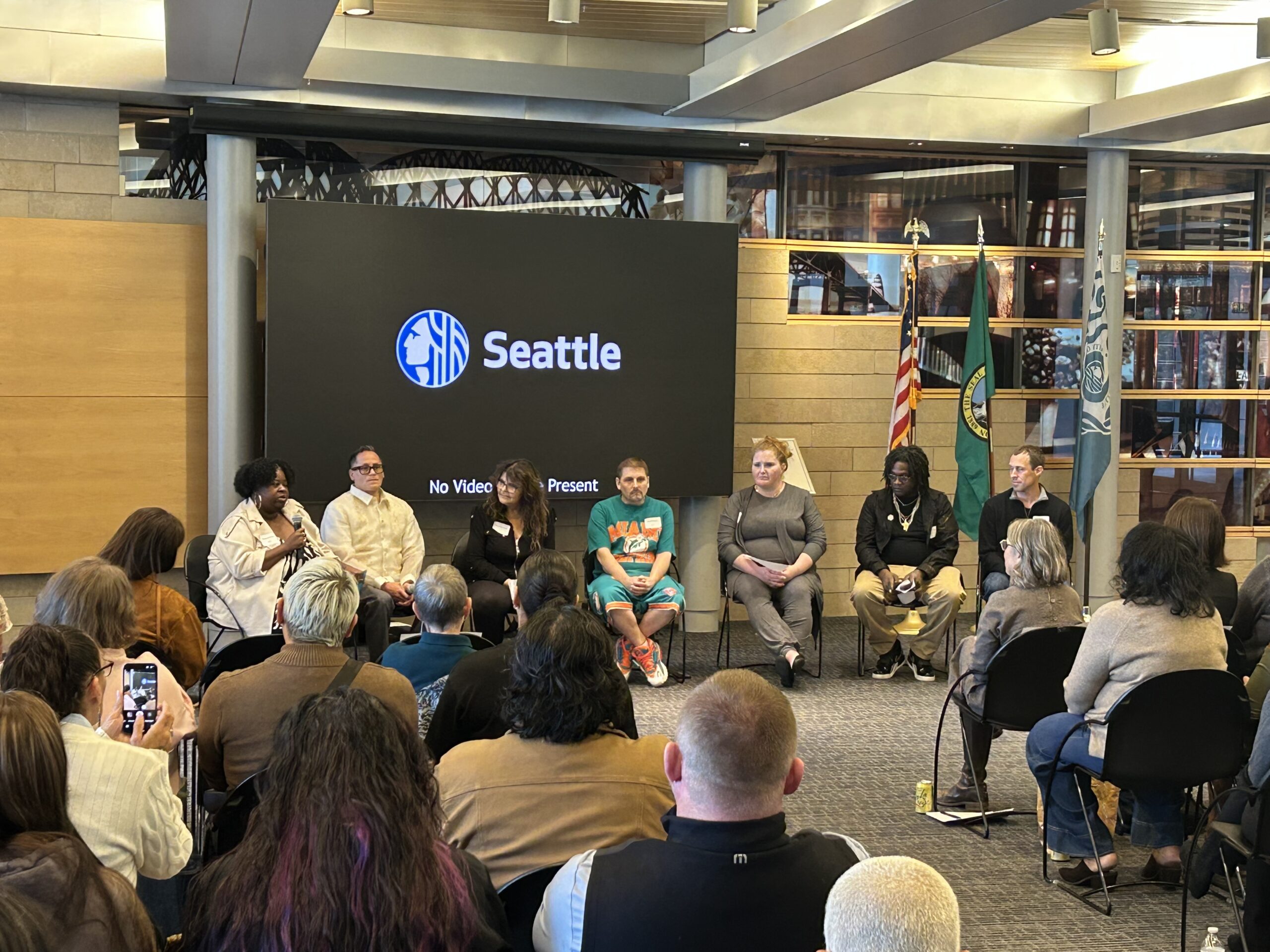
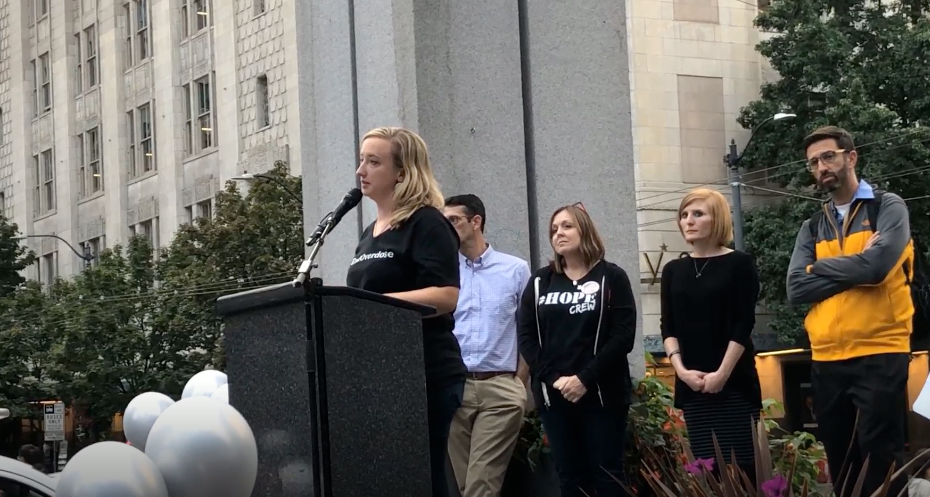
At LEAD’s 15th anniversary celebration at Seattle City Hall, six people who had been through the program sat on a panel and told the room what it meant to them. One woman read from notes she had written so she could get through it without crying. She had used drugs for 40 years. She had been arrested 125 times and gone to prison seven times. She had been hospitalized for psychiatric care more times than she could count. She had lost touch with her children and her family.
“I really felt broken,” she said. Treatment programs and motel vouchers came and went. Then LEAD came along, and she fought it “tooth and nail.”
“LEAD stood by me the whole time, no matter what I did wrong or how far I’d hide,” she said. “Because I would hide.”
Her story is one of many from 15 years of LEAD. Here is how the program started, what it has learned, and where it goes next.
An unusual partnership
Law Enforcement Assisted Diversion, or LEAD, made its first referral on September 28, 2011, in Belltown. It was the first program of its kind in the country. It grew out of years of work by the Public Defender Association, the ACLU, and other groups challenging racial disparities in drug arrests downtown, where Black men were arrested at rates far beyond their share of the city’s population.
It also grew out of frustration inside the Seattle Police Department, which co-designed LEAD on its own initiative. Then–West Precinct Captain Steve Brown was tired of arresting the same people again and again while nothing changed on the street. LEAD gave officers another option. Instead of booking someone into jail for a low-level offense like drug possession, small-scale sales, shoplifting, or trespassing, they could refer that person to a case manager.
“It’s a collaboration of unusual partners to benefit a population that historically hasn’t accessed social services,” said Devin Majkut, associate director of REACH’s Community Justice domain, which houses LEAD. Devin joined REACH as a LEAD case manager in 2014.
Those partners include the King County Prosecuting Attorney’s Office, the Seattle Police Department, and the King County Sheriff’s Office. A project management team holds those relationships together and contracts with REACH to provide case management. In 2011, REACH was the only organization doing the case management. Today three organizations provide LEAD case management in Seattle, and more than 60 LEAD programs operate across the country.
The partnership with police and prosecutors still surprises people. “Our society, our city, our county have certain notions about what those people’s roles are,” Devin said. “You wouldn’t necessarily think of them as people who could be champions for our clients. But they can.”

Brandie Flood, REACH’s director of Community Justice, described the moment LEAD is built around. An officer decides to do something different, at the same time a person decides they are ready to change their life. “And then somebody walks in and says, ‘I’m going to support you and walk on this journey with you.’”
“Is there a catch?”
The people most confused by LEAD at the start were those offered a referral. Many had cycled in and out of jail for years. Then came an arrest that ended differently.
“They’re like, what do you mean? I get arrested, I’m taken to the police precinct, and then this really nice person comes and meets me and talks to me about what’s going on in my life,” Devin said. People asked whether it was a snitch program, or whether they would have to testify against someone.
The answer is no. The only requirement is completing an intake within 30 days of the arrest. After that, there is no clock. Some participants move on after a few engagements with the case manager. Others stay three, four, or six years. Few social service programs work that way, and it has been part of LEAD since the beginning. Today LEAD has a good reputation on Seattle’s streets, and most people accept the referral.
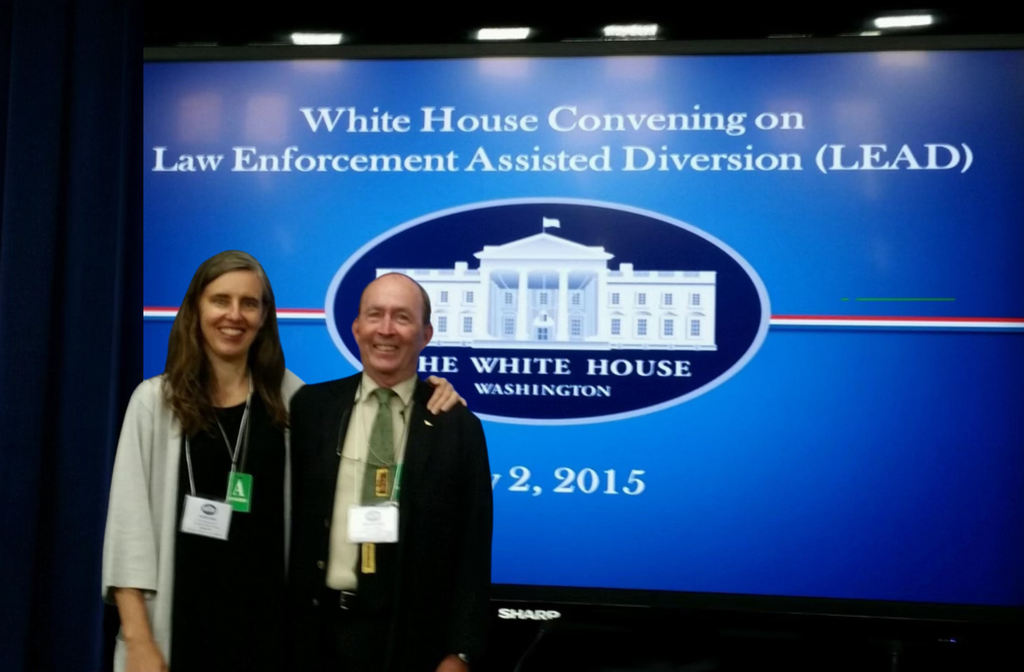
From four staff to a countywide program
In 2011, LEAD had four staff serving 50 to 75 participants in Seattle’s downtown core. Today it covers the whole city and several South King County cities. In 2025, LEAD served more than 1,100 people across King County. That growth is a big part of how REACH grew from a small organization into a large one.
Since 2020, anyone in the community can refer someone to LEAD, not only police. Neighborhood leaders and business owners now make referrals, and LEAD has worked closely with REACH outreach teams on a neighborhood approach. That has brought in people who might never have come through a police referral.
The law has changed too. Drug possession in Washington was once a felony that could mean two years in state prison. It is now a misdemeanor, changing participants decision-making calculus. For some participants, avoiding a charge no longer feels like much of a reason to sign up. What keeps them engaged is the case management itself.
Keys in hand
LEAD is not a housing program, but housing is a goal for many participants. When someone moves into an apartment, their case manager often takes a photo of them holding their new keys and sends it to the team. One panelist put it this way: LEAD gave him “keys to a life that I never thought was possible or that I even deserved.”
Another panelist has had her own apartment for 10 years. She credited Devin, her REACH case manager. “Devin went to bat for me when I didn’t have anybody,” she said. Devin bailed her out of jail and helped her get a Section 8 voucher. Now her children can visit her in a safe home, and she can lock her front door at night.
Other good days look like a court case dismissed or a ride to a visit with a child a participant hasn’t seen in years. More than 70 percent of LEAD participants pursue some form of treatment, trying different approaches until they find what works for them.
The hard days are hard. Participants die of overdose from a toxic drug supply. Plans fall apart because someone doesn’t have an ID, or a criminal record disqualifies them, or a new jail stay means missing a treatment date set for the following week. For participants who come to LEAD in their 40s or 50s with long records, even a property crime can carry a prison sentence of several years.
“It’s hard to change these very large systems that we’re working within,” Devin said.
The next five years
Speaking at the celebration, Seattle Mayor Katie Wilson called LEAD essential to the city’s approach to public safety. “We know that we cannot arrest our way out of the challenges facing our neighborhoods, and we’ve never been able to,” she said. “What we can do is build a system with more than one door so that when someone is struggling, there’s a path towards stability instead of just a path to a jail cell.”
She also acknowledged that providers have faced real budget pressure in recent years and have had to do more with less. “LEAD is not a side program,” she said.
As LEAD looks toward its 20th anniversary, Devin points to two things it needs. The first is a continued strong partnership with prosecutors and law enforcement, to keep chipping away at a legal system that, in her words, “targets people living in extreme poverty, people of color, people that use drugs.”
The second is a willingness to change. “Who a LEAD client is changes as our city changes,” she said. “We need to be flexible.”
Room to try again
The woman who read from her notes is 60 now. She got her first driver’s license and her first job at 55. She has rebuilt her relationships with her children. And she rebuilt her relationship with her mother.
Her mother was diagnosed with cancer in May and died in July. “Because of LEAD and the support they gave me and the things they taught me, I was able to be there for my mom through hospice,” she said. “I was there till she took her last breath.”
For Devin, her story shows what LEAD does differently. After a lifetime of programs built around chances to fail, LEAD gave her “opportunities to try and try again until she found the path that was right for her.”
Fifteen years in, that is still the idea at the center of the work.